
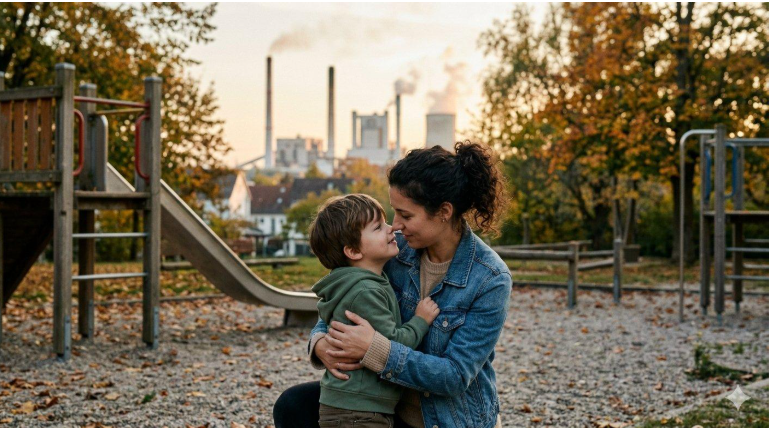
Children living near industrial areas face heightened exposure to harmful air pollutants from their earliest years of life (Disclaimer: The images used in this article are AI-generated for illustrative purposes (Google Gemini) and do not depict real individuals or specific locations.)
On World Health Day 2026, the message from the WHO Regional Office for Europe – “Together for Health, Stand with Science” – reflects a shared commitment to science as a foundation for better health policies and societal wellbeing.
Within this context, the MISTRAL project contributes new scientific evidence on the relationship between environmental exposure and human health, with a particular focus on vulnerable populations.
A New Study on Air Pollution and Pediatric Brain Tumors
To mark this occasion, researchers involved in MISTRAL have published a systematic review in Current Environmental Health Reports, providing a comprehensive analysis of the association between air pollution and brain tumors in children.
The study reviewed 14 epidemiological investigations conducted in the United States, Europe, and Australia, covering large population cohorts.
The main finding indicates that exposure to polycyclic aromatic hydrocarbons (PAHs) – pollutants generated by the combustion of coal, biomass, and fossil fuels — during pregnancy and early childhood is associated with an increased risk of developing pediatric brain tumors, including medulloblastoma and other neuroectodermal tumors.
These results reinforce the growing body of evidence linking environmental pollution to adverse health outcomes from the earliest stages of life.
Early-Life Vulnerability to Environmental Exposure
Children represent a particularly sensitive population group in environmental health research. During early development:
- The brain undergoes rapid growth and differentiation
- Protective biological mechanisms are not yet fully developed
- Exposure to pollutants can interfere with critical developmental processes
This increased vulnerability highlights the importance of preventive strategies targeting environmental risk factors from pregnancy onwards.
The Contribution of MISTRAL
The findings of this publication are part of the broader scientific framework of the MISTRAL project, funded under Horizon Europe. MISTRAL aims to develop advanced tools for dynamic Health Impact Assessment by integrating environmental, clinical, and socio-economic data. The project is currently implemented in three European case studies: Taranto (Italy), Rybnik (Poland), and Hasselt/Genk (Belgium).
Key activities include:
- Collection of primary data through population-based studies
- Integration of environmental exposure indicators with health outcomes
- Development of predictive models based on artificial intelligence
- Deployment of secure digital infrastructures for federated data analysis
These efforts support the development of models capable of estimating the impact of environmental factors on quality of life, disease burden, and healthcare costs.
Implications for Public Health and Policy
The results of this research underline the need for strengthened preventive measures, including:
- Stricter air quality standards
- Reduction of emissions from traffic and industrial sources
- Targeted protection strategies for pregnant women and children
- Improved monitoring of environmental exposures
By translating scientific evidence into actionable knowledge, MISTRAL contributes to more informed and effective public health policies.
Science as a Basis for Collective Action
On World Health Day 2026, the message “Stand with Science” acquires concrete meaning. Understanding how environmental factors affect health is essential for designing interventions that improve population wellbeing and reduce health inequalities.
MISTRAL contributes to this objective by advancing knowledge, developing innovative tools, and fostering dialogue between science, policy, and society.
Reference: Pietrzak, D., Zaręba, M., Stolecka, A. et al. Air Pollution and Brain Tumors in Children. A Systematic Review. Curr Envir Health Rpt 13, 13 (2026). https://doi.org/10.1007/s40572-026-00533-x