
About the MISTRAL Project
A toolkit for dynaMic health Impact analysiS to predicT disability-Related costs in the Aging population based on three case studies of steeL-industry exposed areas in europe.

Air Pollution
Our main ambition is to reduce air pollution due to industry in Europe

Health
There is a direct connection between air pollution and health, that we will analyse

Socio-economic cost
Global quality of life and health of citizens affect socio economic conditions in European cities

City
3 representative cities in Europe selected for our studies about air pollution, health and socio-economic cost
News & Events
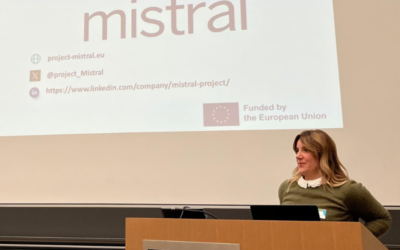
MISTRAL at Citizen Science for Health 2025
MISTRAL marked an important milestone with its first participation in the Citizen Science for...

Clean Air in the City Seminar
We’re thrilled to share that Agnieszka Gruszecka-Kosowska from WGGiOŚ – AGH University of Krakow...
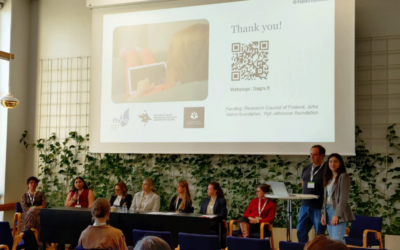
European Public Health Conference
The MISTRAL project marked an important milestone this year with its first participation in the...
Federated Learning: Intelligence Without Moving Data
In our virtual infrastructure, federated learning plays a central role.
Unlike traditional machine-learning pipelines—where data must be transferred, centralized, and stored on remote servers—federated learning enables intelligence to grow where the data lives. A central server coordinates the process, but never sees the raw data. Local devices, institutions, or data providers train the model independently on their own datasets. What travels back and forth are only anonymized model parameters, never personal or sensitive information. It is the technological backbone that allows the project to simulate and test urban health policies using real-world data—without ever moving the data itself.
In our virtual infrastructure, federated learning plays a central role.
Unlike traditional machine-learning pipelines—where data must be transferred, centralized, and stored on remote servers—federated learning enables intelligence to grow where the data lives. A central server coordinates the process, but never sees the raw data. Local devices, institutions, or data providers train the model independently on their own datasets. What travels back and forth are only anonymized model parameters, never personal or sensitive information. It is the technological backbone that allows the project to simulate and test urban health policies using real-world data—without ever moving the data itself.


Our European Case Studies
To understand how environmental pressure shapes urban health, MISTRAL works with three post-industrial European regions that share a strong legacy of steel and heavy industry.
Taranto in southern Italy
Rybnik in Poland
Hasselt/Genk in Belgium
These territories face long-standing challenges linked to air pollution, industrial emissions, and socio-economic inequalities. By combining their real-world environmental and health data, we train AI models capable of predicting how current and future industrial policies may impact the wellbeing of citizens.Our goal is to transform these diverse urban experiences into evidence-based tools that help local governments design healthier, more resilient cities.